The Peace Abbey Landmine Project
The core initiative of the Landmine Project is to engage and educate the general public on the devastating humanitarian crisis of unexploded ordnance.
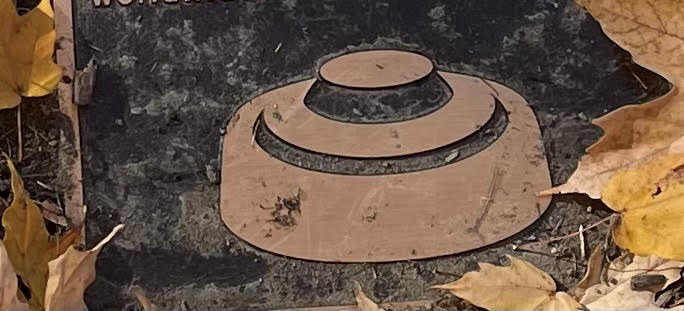
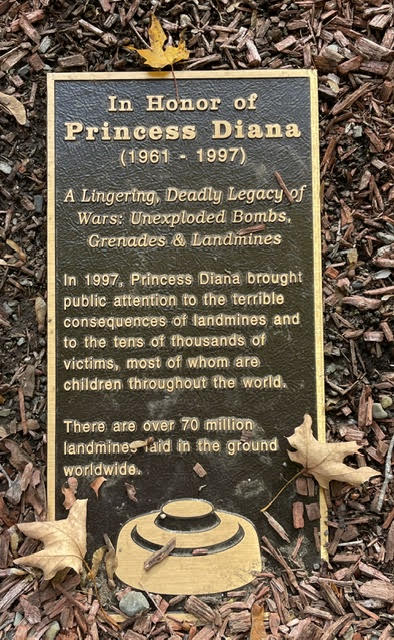
The Peace Abbey’s in-ground memorial plaque honoring Princess Diana (shown below) recognizes her extraordinary humanitarian work in bringing worldwide attention to the devastating impact of landmines on civilian populations. By visiting minefields and survivors, Diana helped transform public awareness and inspired international efforts to ban anti-personnel landmines and support those affected by them.
Her legacy is closely linked to that of Maha Ghosananda, the Cambodian Buddhist monk known as the “Gandhi of Cambodia.” Having witnessed the devastation of war and landmines in Cambodia, he dedicated his life to peace, reconciliation, and healing through his annual Peace Walks.
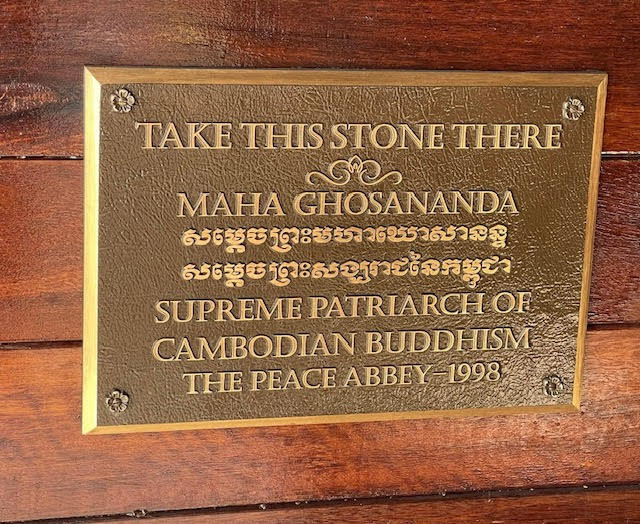
During a visit to the Peace Abbey in Sherborn, MA where he received the International Courage of Conscience Award, Maha Ghosananda visited the Memorial for Unknown Civilians Killed in War and asked whether a similar memorial stone existed in Washington, D.C. When Lewis Randa, Director of the Peace Abbey, explained that it did not, Maha Ghosananda simply replied, “Take this stone there.”
 His words inspired the international journey of the civilian memorial stone known as Stonewalk, a continuing pilgrimage honoring innocent victims of war and violence and promoting peace and reconciliation. Civilian Memorial Stones have been physically pulled from Boston, MA to Washington, DC; Dublin, IRL to Belfast, N. IRL; Liverpool to Coventry, ENG; Nagasaki to Hiroshima, JPN and from the southern tip of South Korea to the DMZ.
The Landmines Project connects these powerful legacies by educating the public about the ongoing humanitarian impact of landmines while honoring those who have dedicated their lives to protecting civilians. Through Princess Diana’s advocacy, Maha Ghosananda’s spiritual leadership, and the Peace Abbey’s commitment to remembrance, the project encourages public support for organizations working to remove landmines, assist survivors, and build a more peaceful world.
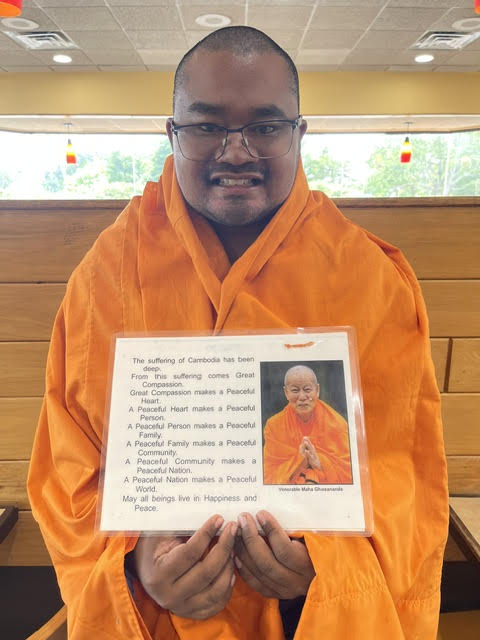
The Abbey is proud to announce the involvement of volunteer project assistant John Gates shown in the photo below wearing the saffron shawl gifted to the Peace Abbey by Maha Ghosananda during his 1998 visit.
- Raise Public Awareness: Drive global and local attention to the ongoing dangers of weapon contamination.
- Highlight Historical Realities: Anchor public discourse on heavily affected areas, specifically focusing on the legacy of conflict in Cambodia.
- Inspire Grassroots Action: Mobilize civilian communities to support international de-mining and peacebuilding efforts.
        [ Memorial Prayer in Massachusetts ]
                                   │
         Maha Ghosananda honors a civilian victim monument
                                   │
                                   ▼
         Asked if a similar tribute exists in Washington D.C.
                                   │
                                   ▼
               "Take this stone there." — Maha Ghosananda
                                   │
                                   ▼
          [ The Birth of Stonewalk: Foot Pilgrimage to D.C. ]
Landmine Project
International Law and the United States
Land mines continue to pose one of the greatest long-term humanitarian dangers of modern warfare, often remaining active decades after conflicts have ended and claiming the lives and limbs of civilians, especially children.
In 1997, the international community adopted the Ottawa Treaty (Land Mine Ban Treaty), an agreement that prohibits the use, production, stockpiling, and transfer of anti-personnel land mines.
More than 160 nations have joined the treaty, recognizing that the devastating human cost of these weapons outweighs any military advantage.
The United States is not a party to the Ottawa Treaty. Instead, it participates in the Convention on Certain Conventional Weapons (CCW), which regulates the use of land mines rather than banning them outright.
The continuing global debate over land mines reflects a profound moral question: Can any weapon that continues to kill and maim innocent people long after war has ended ever be justified?
The Peace Abbey’s Land Mines Project invites the general public to consider this question and to join the worldwide movement dedicated to eliminating these indiscriminate weapons, clearing contaminated land, assisting survivors, and building a future where no child lives in fear of taking the next step.