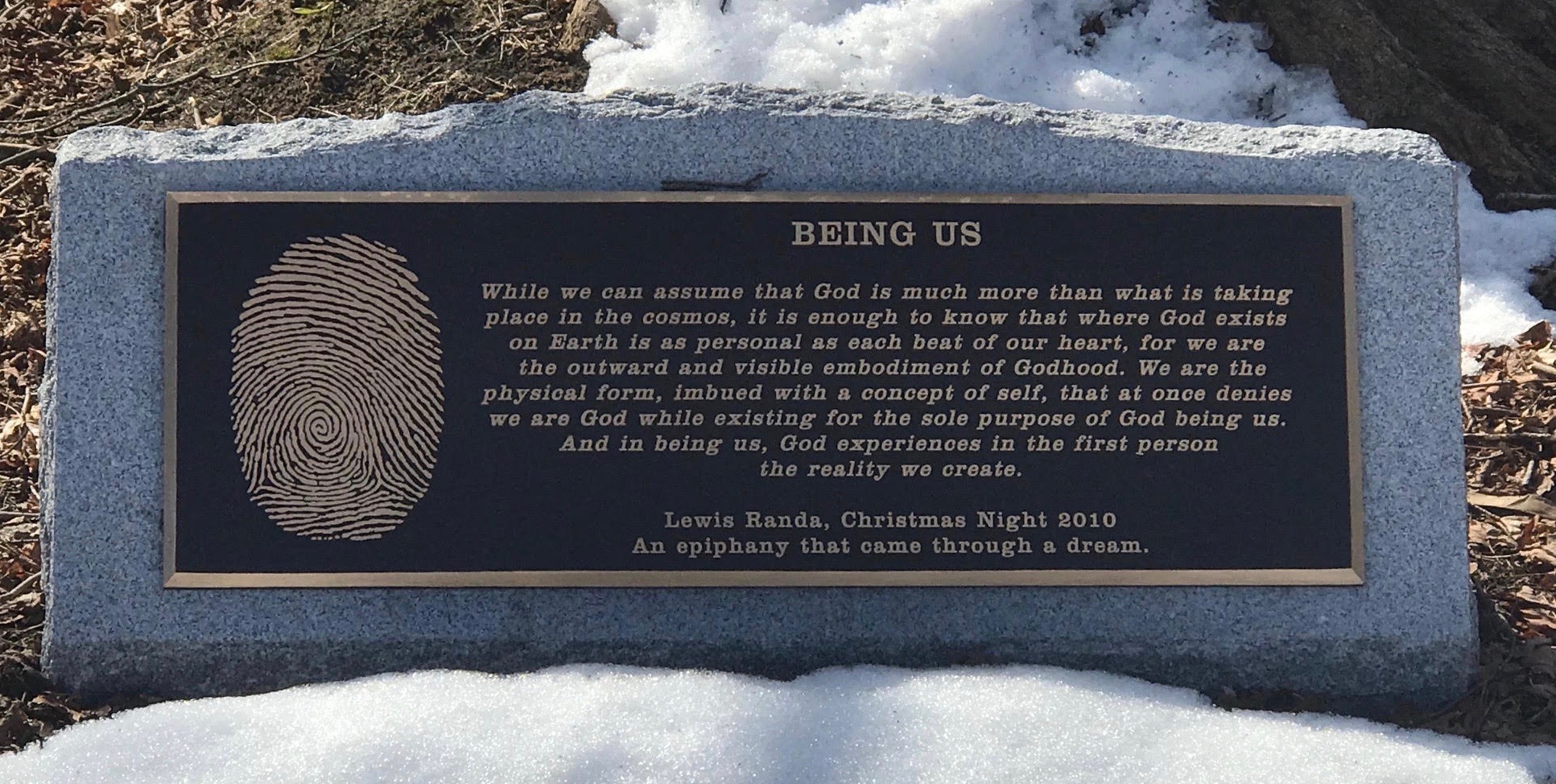
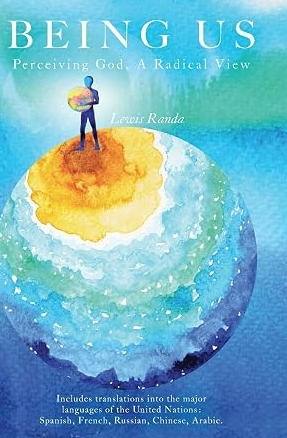
Being Us Perceiving God, a Radical View by Lewis Randa was written to be read in a matter of minutes, with the hope that the awareness it offers the reader might matter for a lifetime.
The book emerged from a profound personal transformation following the tragic death of a close friend of Randa’s daughter in 2010. During a period of grief and deep questioning, he experienced a vivid and life-altering dream that settled, in his mind, the question of whether there is a personal God guiding human existence. What the dream revealed was a radically different perception of the divine, one not separate from life, but inseparable from it.
Rather than seeing God as an external being existing outside the universe alone, Randa came to understand the divine as both beyond the universe and within it, present throughout all existence and consciousness itself. Humanity, nature, and what many call God are portrayed not as separate realities, but as expressions of a larger interconnected whole.
Blending ideas associated with Eastern philosophy, mysticism, and spiritual non-duality, Being Us challenges traditional distinctions between God, self, and creation. Suffering and tragedy are explored not as evil or randomness, but as part of a deeper reality often hidden from human understanding.
Written in a succinct, conversational style rather than academic language, the book was intentionally crafted so readers of all ages and backgrounds could connect with its message, an invitation to see themselves, others, and life itself through a deeper sense of unity, meaning, and shared existence. BEING US was published by Palmetto Press in 2022.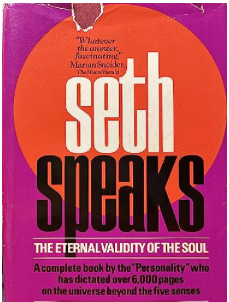
Comparative Analysis of Seth Speaks and Being Us: Perceiving God, a Radical View
Jane Roberts’ Seth Speaks and Lewis M. Randa’s Being Us: Perceiving God, a Radical View are separated by nearly half a century, yet they share a common purpose: to challenge conventional assumptions about God, consciousness, and the nature of reality. While they arise from very different origins, both books invite readers to undergo a profound shift in perception rather than simply adopt a new belief system.
Different Paths to Similar Questions
The most striking difference between the two books lies in their source of authority.
Seth Speaks presents itself as a series of teachings communicated through Jane Roberts by an entity named Seth. Readers are asked to consider that the knowledge originates beyond ordinary human consciousness. Consequently, the book constructs an elaborate metaphysical framework encompassing reincarnation, probable realities, multidimensional existence, and the creative power of belief.
Being Us, by contrast, is grounded in Lewis Randa’s personal experience and philosophical reflection. Rather than claiming revelation from an external intelligence, it asks readers to reconsider their understanding of God through observation, reason, spiritual experience, and the implications of panentheism. The authority rests not in channeling but in thoughtful inquiry.
Consciousness as Fundamental
Despite their different origins, both books agree on one essential premise: consciousness is more fundamental than matter.
For Seth, physical reality is the expression of consciousness. Human beings continually create their experience through their beliefs, expectations, and intentions.
In Being Us, consciousness likewise occupies a central role, although its emphasis is relational rather than mechanical. Rather than focusing primarily on how beliefs create reality, Randa explores how consciousness reveals humanity’s unity with the Divine. Consciousness becomes the means through which we recognize our participation in a greater whole.
The Nature of God
Perhaps the greatest philosophical overlap concerns the nature of God.
Neither author accepts the traditional image of God as a distant supernatural ruler who intervenes selectively in human affairs.
Instead:
- Seth describes an all-encompassing creative reality often referred to as “All That Is.”
- Randa describes a God understood through panentheism, in which the universe exists within God while God simultaneously transcends it.
Although the terminology differs, both perspectives move away from dualism toward an understanding of God as the very ground of existence itself.
Human Identity
Both books reject the notion that human beings are isolated individuals.
Seth Speaks portrays each person as a multidimensional consciousness existing simultaneously across many realities.
Being Us approaches the same conclusion from another direction: our apparent separateness is an illusion that obscures our participation in one shared reality. Humanity is fundamentally interconnected because all existence participates in the Divine.
Where Seth emphasizes multidimensional identity, Randa emphasizes relational unity.
Purpose of Life
The books also differ in their understanding of life’s purpose.
For Seth, life functions as an arena for creative exploration in which consciousness continually expands through experience.
For Randa, life becomes an opportunity to awaken to our true relationship with God and with one another. Spiritual maturity consists less in mastering metaphysical principles than in recognizing our shared identity and living accordingly.
Style and Accessibility
The books differ considerably in style.
Seth Speaks is expansive, intricate, and highly metaphysical. Its discussions of reincarnation, parallel realities, and psychic phenomena can challenge even experienced readers.
Being Us is more philosophical and theological. While it asks readers to rethink deeply held assumptions, its central argument remains focused on one overarching question: What does it mean to perceive God differently?
This narrower focus makes its argument more unified, even as it remains intellectually provocative.
Shared Contribution
Ultimately, both books seek to transform perception rather than merely convey information.
They encourage readers to move:
- from fear to understanding,
- from separation to unity,
- from external authority to personal discovery,
- from rigid religious dogma to direct spiritual inquiry.
Each book invites readers to see reality through a larger lens in which consciousness, rather than material existence alone, defines who we are.
Conclusion
Seth Speaks offers an extensive metaphysical cosmology explaining how consciousness creates reality across multiple dimensions. Being Us offers a philosophical and theological reimagining of humanity’s relationship with God through the framework of panentheism and shared consciousness.
Together, the books may be viewed as complementary rather than competing works. Seth explores the architecture of consciousness; Randa explores the meaning of consciousness in relation to God. One seeks to explain how reality works; the other asks what reality ultimately means.
For readers interested in spirituality beyond traditional religion, both books encourage a profound reconsideration of existence. Their greatest commonality is not any single doctrine, but their shared invitation to awaken—to perceive ourselves, one another, and the Divine through an entirely new way of seeing.