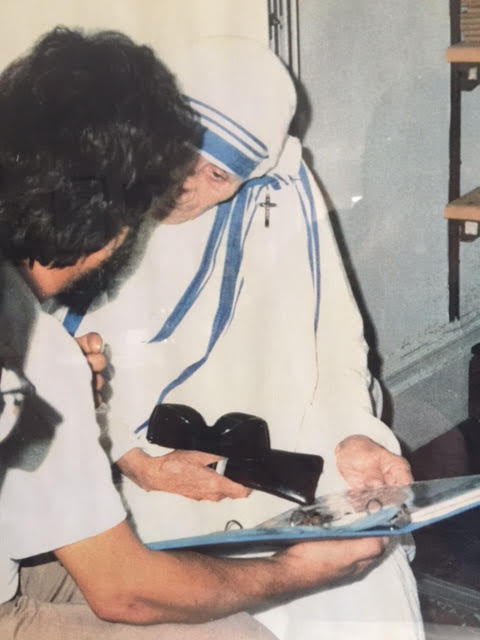
Lewis Randa meets with Mother Teresa to review translation of the prayers for peace before his visit to Medjugorje, Yugoslavia in 1989.
 *
*



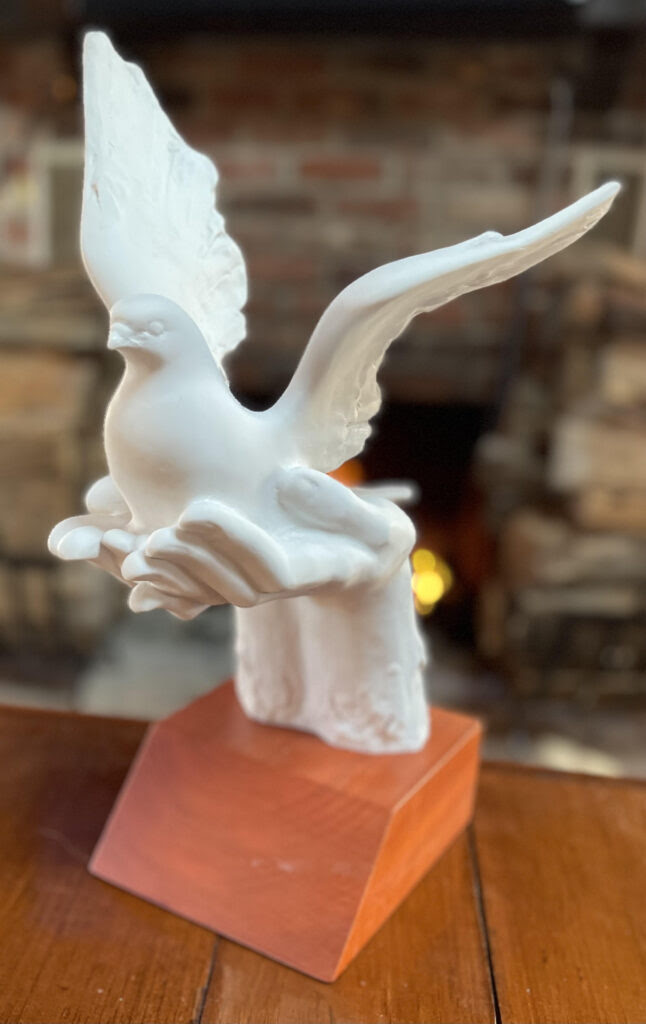
PEACE CHAPLAINCY
Multifaith Peace Chaplains are commissioned by the Peace Abbey to participate in peace and social justice activities and are registered in the Commonwealth of Massachusetts with the authority to officiate at wedding ceremonies. Chaplains are also available to perform infant blessings, wedding vow renewals, funerals, memorial services and invocations at peace events.

The Peace Seeds Rosaries with the St. Francis or Gandhi medallion are available for a nominal contribution of $10.00. The prayer pamphlet of the 12 major faith traditions can be downloaded here.
From the friend who makes Peace Seeds Rosaries from beads strung by students at LES: “Looking around at what happens in the world every day, I come close to feeling like “They do no good at all. None of what I do matters. On a more local level though, there are hints that Peace Seeds Rosaries are much more than ‘no good at all’… Little stories of people who receive these interfaith prayer beads and what they mean to them come to me. Like rain, drop by drop, these small stories soften the hardened doubt that gnaws at me.” – Roy Goodwin


Cape Cod Quaker Gazette:
Why Go to Friends Meeting?
by Lewis Randa
Over the years, I’ve often been asked why I attend Quaker meeting and what I get out of it. My answer varies, but it always draws on what I’ve experienced in Friends meetings over the past half century, and on the peacefulness and quiet strength I find on a walk around the bog or through wooded areas.
Forest bathing (as some refer to it) and Quaker meeting for worship share certain undeniable qualities: both are gentle immersions in a tranquil and peaceful atmosphere, and both require openness more than effort.
Forest bathing invites slowing down, setting aside goals and devices, and letting the colors, shapes, sounds, and scents of the woods seep and speak into one’s awareness until the forest’s spirit and presence settle in and the body and mind are refreshed—healed even. The forest does most of the “work”; our task is simply to walk, linger, breathe, see, and allow this living presence to wash through the senses. Gail Melix’s recent article in Friends Journal says it best.
Meeting for worship begins similarly, as Friends gather in shared silence and lay aside busyness to become inwardly attentive and open. There is no sermon to consume or evaluate, only the simple practice of sitting, breathing, and staying open to “that of God” that surrounds and dwells in everyone and in everything.
At times, the silence deepens into a gathered state, when the room feels held in a quiet unity that no one person controls. It’s impossible to fully define, but it has shaped me in ways that keep drawing me back, though the reasons shift over time.
Meeting for worship is where our hearts and souls cross-pollinate in a silence that asks nothing more of us than to stay open and absorb the essence of those who surround us.
Both the forest and the meeting room teach that the peace we seek outside is a reflection of the peace within ourselves and within the community turned inward together. Trees and plants share light, air, and soil, shaping the space in which one stands; those at Quaker meeting share consciousness, faith, and tenderness, shaping the silence in which we all sit.
To hug a tree is to lean into forest bathing; to share spoken ministry during meeting is to lean into a human forest where we are bathed in a deeper awareness through shared insights and epiphanies.
The thing about hugging a tree is that there is no other living being you can hug that reaches down into the Earth and up to the sky—that was here before you were born and will be here long after you die.
In both settings, our consciousness cross-pollinates: with fellow Friends at meeting and with the expressions of nature that crawl, walk, fly, and burrow, and with the trees and plants that sustain them. In each setting, we find ourselves strengthened for whatever step faith asks of us next.
Whether at the rise of meeting or stepping out of the woods, it is often clear that you are leaving a fuller human being than you were when you first arrived. The power of nature and the power of human nature have together held a place in my spiritual journey. In the end, attending Friends Meeting is like a quiet walk in the woods: I go because it helps me return to myself and to what matters most.
“The best way to find yourself is to lose yourself in the service of others.”
– Mahatma Gandhi
Join Our Mailing List

The Mission Continues!
REMEMBER TO BE KIND