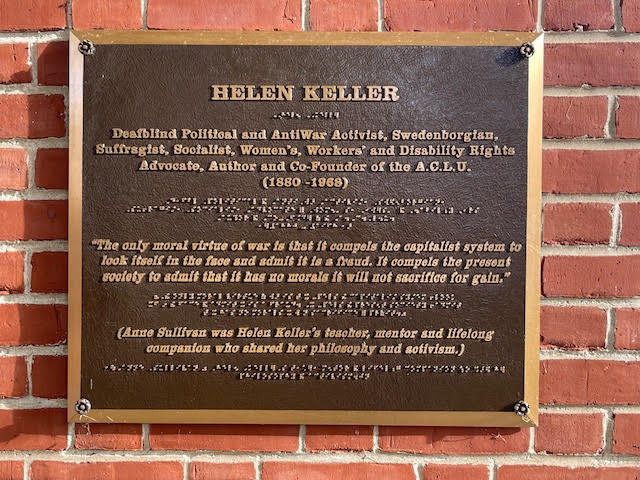
EXHIBIT MISSION STATEMENT
The Anne Sullivan and Helen Keller Traveling Exhibit seeks to promote a heightened appreciation of the relationship between these two extraordinary women in history.
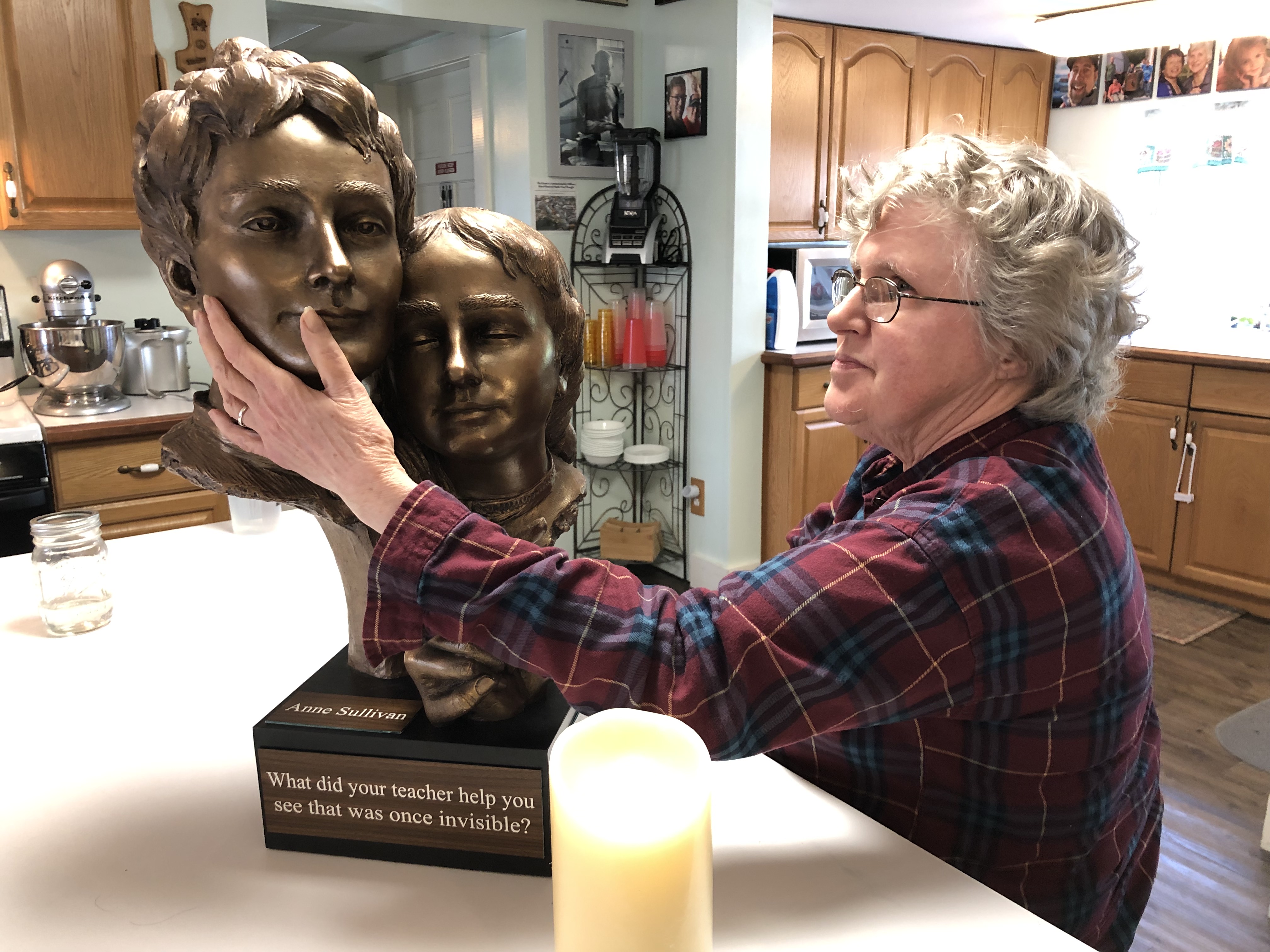
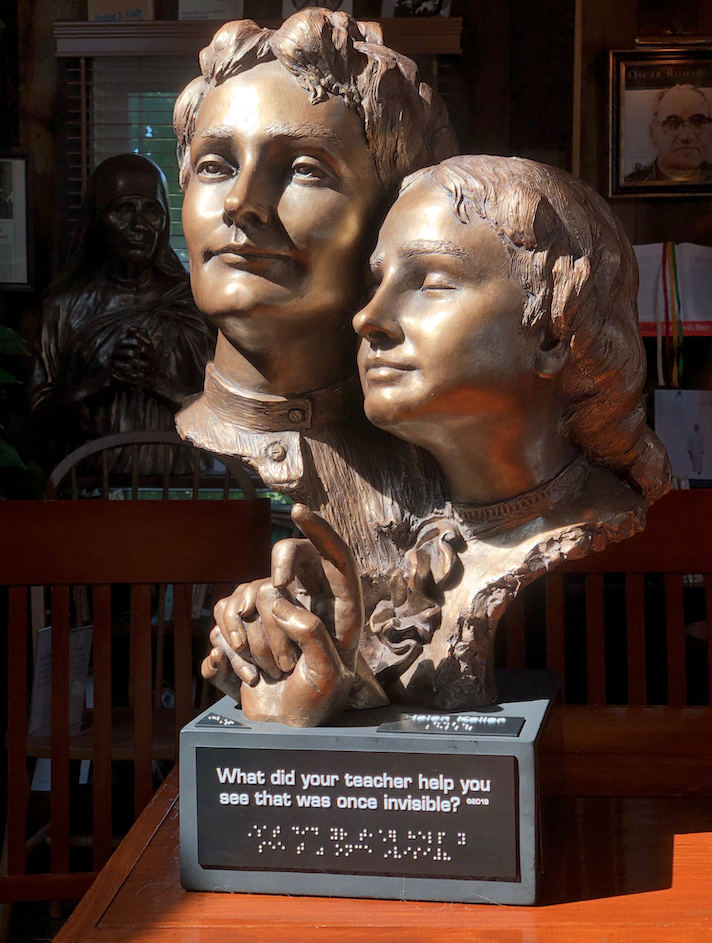
The exhibit’s primary focus is to showcase the vital role teachers have played in our lives. This is addressed through the two queries in text and braille on the base of the statue: What did your teacher help you see that was once invisible? What did your teacher help you hear that was once silent?
Exhibit strives to:
- Inspire further interest in the lives of Anne Sullivan and Helen Keller
- Present information about the extraordinary dynamics between these two individuals
- Elevate the importance of teachers in our lives
- Encourage opportunities to discuss particular teachers in our lives
- Highlight the importance of accepting differences
- Promote tolerance, diversity, and inclusion
- Serve as an extension to school and art center projects and programming
- Place exhibit in a broad range of community locations
- Educate the public about the contributions of other peacemakers whose statues are exhibited as part of the Public Peace Art Program
The goal of the Public Peace Art Program is to present to the general public original, commissioned statues of peacemakers who have inspired visionary thinking and a commitment to peaceful social change. Both permanent and temporary (traveling) placement of statues is under the care of The Peace Abbey Foundation.
Cost: Free of charge. Contributions are welcome. The Peace Abbey is a nonprofit, tax-exempt, charitable organization founded in 1988. Those interested in underwriting this exhibit may contact us at lewismranda@gmail.com.
A Gift of Conscience
By Lewis Randa
Forty years ago, during the celebration of Tewksbury’s 250th anniversary, this community commissioned and dedicated the life-size bronze statue of Anne Sullivan and Helen Keller that stands on the front lawn of Town Hall. Entitled Water, the sculpture commemorates the moment that changed history; the instant Helen Keller first grasped the connection between language and the world around her.
The artist, Mico Kaufman, made a remarkable choice. Rather than immortalize a president, a general, or a battlefield victory, he chose to capture a teacher and a student in the very act of learning. In doing so, he created a monument to education, human connection, and the transformative power of teaching itself. It was, and remains, a profound statement. Most public monuments celebrate power. This one celebrates possibility.
Anne Sullivan and Helen Keller remind us that the greatest force in society is neither wealth nor authority. It is the ability of one human being to awaken the potential of another.
The relationship between teacher and student is among civilization’s most sacred bonds. Every generation inherits knowledge, wisdom, and experience from those who came before. Every advance in science, medicine, literature, democracy, and human understanding is carried forward through this enduring partnership. It is the bridge between the past and the future.
Anne Sullivan understood that truth. She did not see Helen Keller as a disability to be managed. She saw a mind waiting to be opened and a spirit waiting to be liberated. She recognized not limitation, but possibility.
Helen Keller responded with extraordinary determination. Together, they demonstrated what can happen when one person refuses to give up on another and when a student refuses to surrender to debilitating circumstances.
Their partnership transformed not only their own lives but the lives of millions around the world.
For Tewksbury, this story carries special meaning. Anne Sullivan’s journey began here amid hardship and adversity. From the difficult years she spent at the Tewksbury Almshouse emerged one of the most influential teachers in American history. That is why this town chose to honor Sullivan and Keller during its own 250th anniversary celebration. The statue stands as a permanent reminder that greatness often grows from the most unlikely beginnings and that compassion, perseverance, and faith in another human being can change the course of history.
Now, as we celebrate the 250th anniversary of the United States, that message feels more important than ever.
The American experiment rests upon a simple but revolutionary belief: that every person possesses inherent dignity, worth, and untapped potential. Anne Sullivan and Helen Keller embodied that belief. Their lives demonstrated that when we invest in one another, barriers can be overcome, lives can be transformed, and possibilities can become realities.
The bust gifted to the Town of Tewksbury by the Peace Abbey Foundation, sculpted by renowned artist Lado Goudjabidze, is more than a work of art. It is a gift of conscience; a tribute to hope, education, perseverance, and the enduring power of a teacher’s faith in a student.
It reminds us that the future is built whenever one person reaches out to another and says, “I believe in you.”
It is with deep admiration for Anne Sullivan and Helen Keller that the Peace Abbey Foundation presents this sculpture, honoring the extraordinary bond between two remarkable women. Their lives stand as enduring testimony to the transformative power of education, perseverance, and devotion; not only to one another, but to the betterment of humanity.
Identical casts of this sculpture have been gifted to the Perkins School for the Blind and to the Helen Keller Birthplace Foundation in Tuscumbia, Alabama. Together, these three sculptures form a living bridge between the places that shaped their story and the people who continue to draw inspiration from it.
May this gift serve as a lasting reminder that the highest purpose of education is not merely to impart knowledge, but to unlock human potential; and that the greatest monuments are not those built to power, but those dedicated to the human capacity to lift one another up.
PRESENTATION OF SULLIVAN AND KELLER SCULPTURE TO THE TOWN OF TEWKSBURY, MA
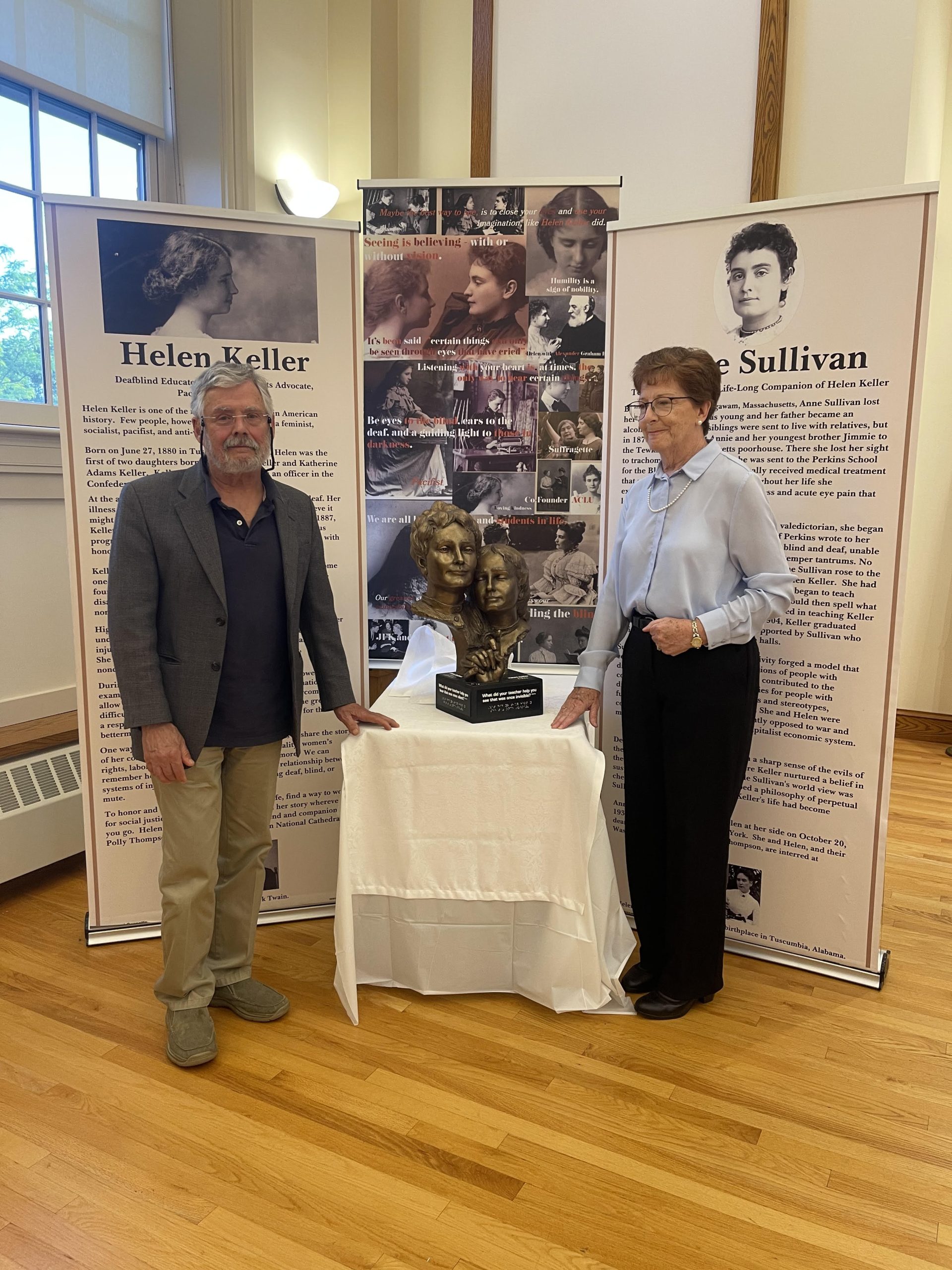
Lewis Randa of The Peace Abbey, and Nancy Reed, Vice President of the Tewksbury Historical Society and town historian, stand with the statue of Anne Sullivan and Helen Keller which was presented to the town during the June 9 Select Board meeting. Sullivan spent time at the Tewksbury Almshouse in the 1800s before transferring to Perkins School for the blind.
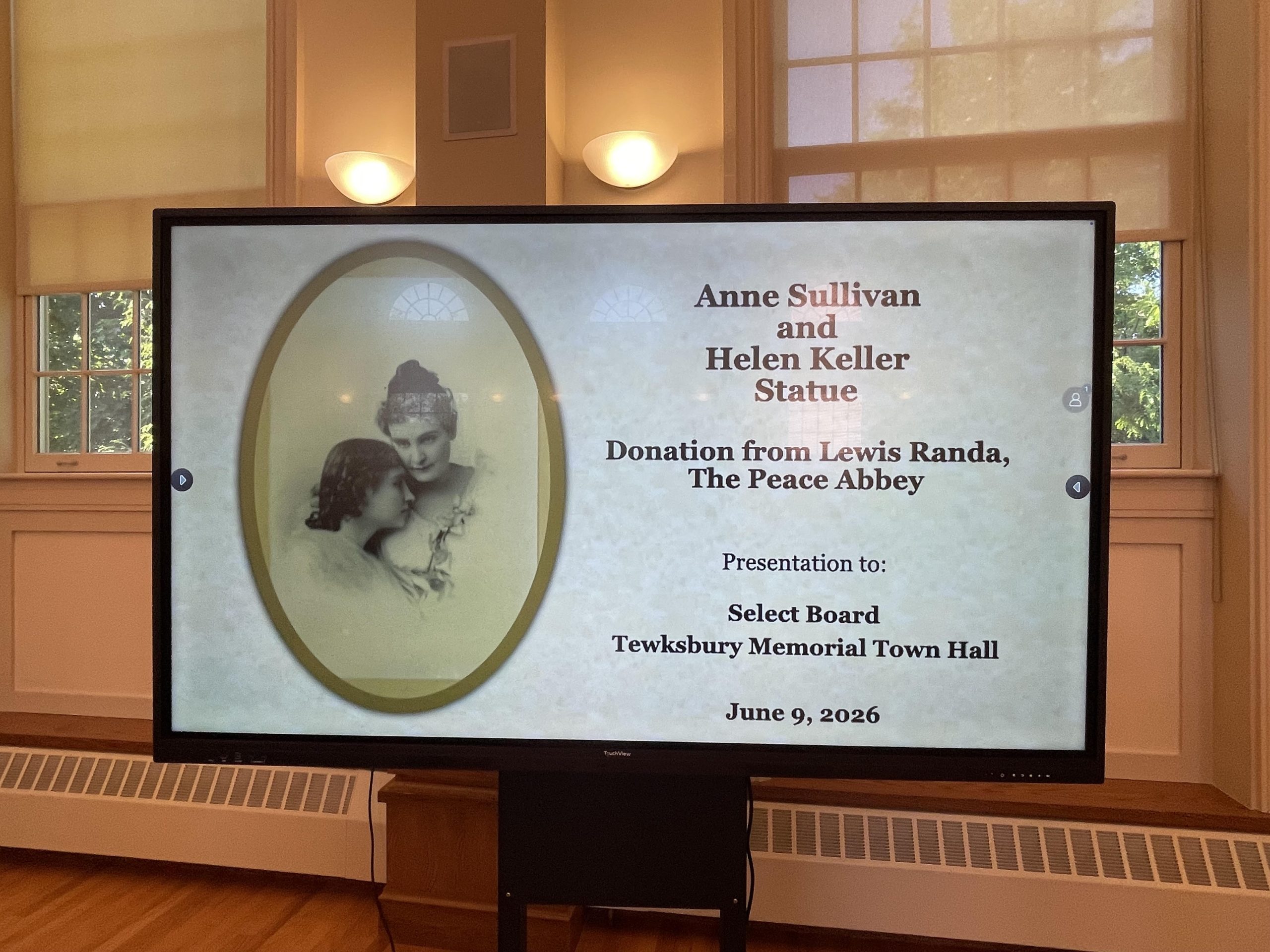
TEWKSBURY — A bronze sculpture depicting Anne Sullivan and her renowned student Helen Keller was donated to the Town of Tewksbury by Lewis Randa, founder and chair of The Peace Abbey Foundation. The presentation was made jointly by Randa and Tewksbury Historical Society Vice President and Town Historian Nancy Reed during the June 9 Select Board meeting.
The sculpture, titled Keller and Sullivan, was created by internationally recognized sculptor Lado Goudjabidze and commissioned to celebrate the transformational relationship between teachers and students. The work was unveiled in 2019 at the Massachusetts Lions Club Convention and has since been displayed at The Peace Abbey in Sherborn.
Reed’s presentation provided historical context on Sullivan’s difficult childhood and her connection to Tewksbury. Born in 1866 to Irish immigrant parents in Feeding Hills, Massachusetts, Sullivan endured tremendous hardship at a young age.
Nearly blinded by an eye infection and devastated by the loss of her mother to tuberculosis, she and her younger brother, Jimmie, were sent to the Tewksbury Almshouse in 1876.
Conditions at the almshouse were notoriously harsh. Sullivan would later describe her time there as “indecent, cruel, melancholy, gruesome.” Her brother died just months after their arrival. It was in Tewksbury that Sullivan’s determination and resilience first became evident.
In 1880, when members of the State Board of Charities visited the almshouse, Sullivan boldly approached board member Franklin Sanborn and pleaded for the opportunity to attend the Perkins School for the Blind. Her request was granted, changing the course of her life.
At Perkins, Sullivan excelled academically despite arriving with little formal education. She mastered the manual alphabet used to communicate with deaf individuals and graduated as valedictorian in 1886.
In March 1887, the 20-year-old teacher traveled to Tuscumbia, Alabama, to work with seven-year-old Helen Keller, who had been deaf and blind since infancy. Through patience, innovation, and an unwavering belief in her student’s potential, Sullivan helped Keller break through the isolation of a world without sight or sound.
Their most famous breakthrough came at a water pump, when Keller realized that the signs Sullivan was spelling into her hand represented words and ideas. The moment opened the door to language, education, and ultimately a lifetime of achievement.
Under Sullivan’s guidance, Keller learned hundreds of words within months and eventually became an author, lecturer, advocate, and one of the most influential figures of the 20th century. She met with numerous U.S. presidents, co-founded Helen Keller International, championed opportunities for people with disabilities, and inspired generations around the world.
Yet as Reed noted during her presentation, Keller’s accomplishments cannot be separated from Sullivan’s extraordinary role as educator and mentor.
Author Mark Twain famously referred to Sullivan as a “miracle worker,” believing she deserved equal recognition for Keller’s achievements. His description later inspired the title of the acclaimed play and film The Miracle Worker.
Sullivan’s methods revolutionized the education of blind, deaf-blind, and visually impaired students. Her emphasis on individualized instruction, tactile communication, patience, and high expectations continues to influence special education today.
Randa reflected on the deeper meaning of the gift and the enduring lessons represented by the sculpture.
“The relationship between Anne Sullivan and Helen Keller remains one of history’s most powerful examples of what can happen when a teacher recognizes possibility where others see limitation,” he said. “Their story reminds us that education is not merely the transfer of knowledge but an act of faith in human potential.”
Randa’s own lifelong commitment to service and nonviolence has shaped the mission of The Peace Abbey, which he founded in 1988 as an interfaith center dedicated to peace education and social justice. The Peace Abbey grounds feature memorials and statues honoring individuals ding Mahatma Gandhi, Mother Teresa, Muhammad Ali, and President John F. Kennedy.
Board members expressed appreciation for the donation and for the collaborative efforts that brought the project before the town.
Reed was also acknowledged for her extensive work organizing the presentation and researching the history behind the sculpture and the lives of Sullivan and Keller.
IIt is with deep admiration for Anne Sullivan and Helen Keller that the Peace Abbey Foundation presents this sculpture, honoring the extraordinary bond between two remarkable women. Their lives stand as enduring testimony to the transformative power of education, perseverance, and devotion; not only to one another, but to the betterment of humanity.
___________________________________________________________
ANNE SULLIVAN & HELEN KELLER
TRAVELING EXHIBIT
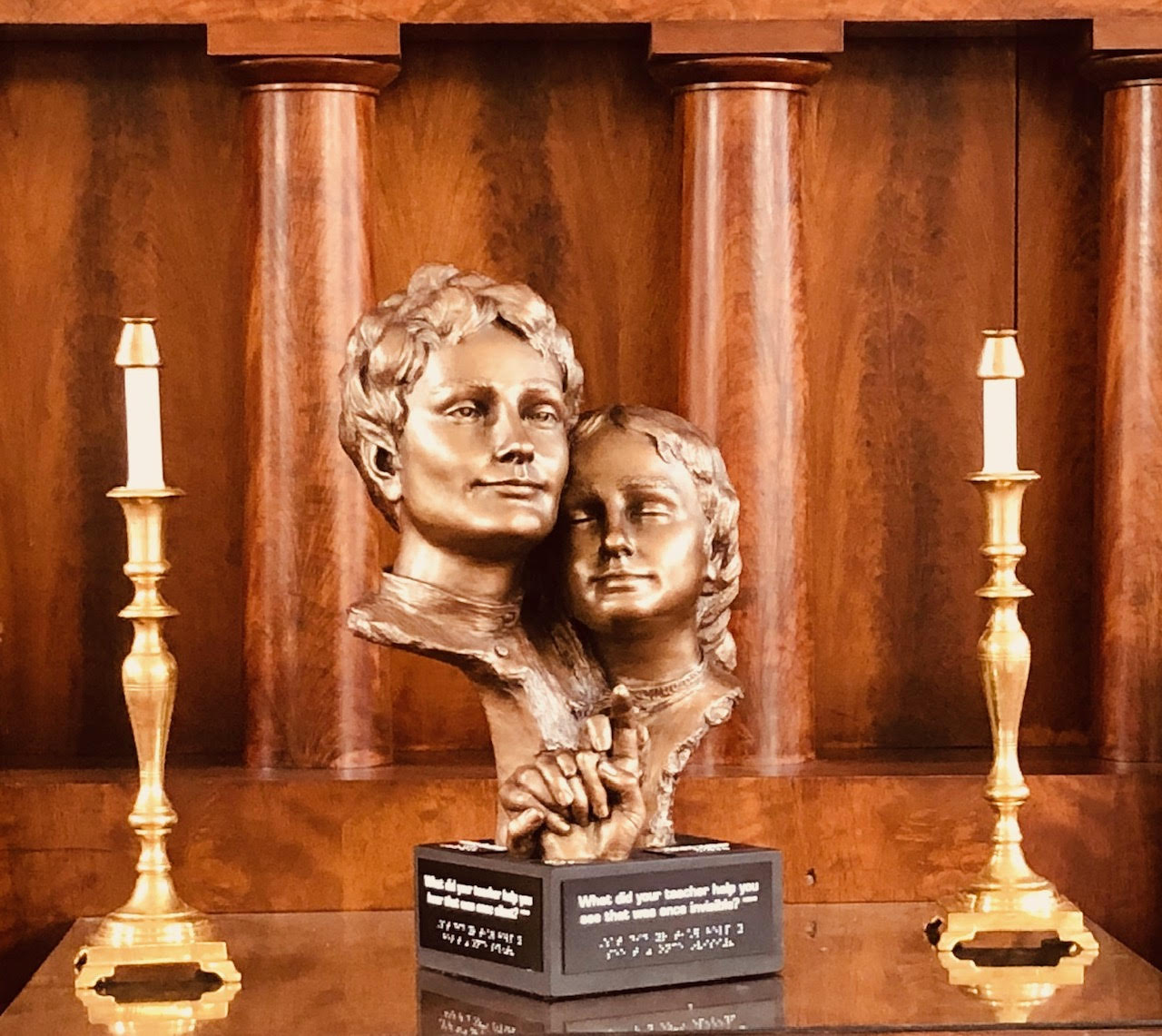
Sculpture of Anne Sullivan and Helen Keller
Traveling Inclusion Exhibit launches in Duxbury, MA
Duxbury, MA – Town residents Lewis and Meg Randa are delighted to announce the launching of the Anne Sullivan and Helen Keller Traveling Exhibit in Duxbury during the month of November. The exhibit features the beautiful, life-size bronze bust of Helen Keller and her teacher and mentor, Anne Sullivan. The work of art was commissioned to celebrate the unique and transformational relationship children and adults have with their teachers.
This one-of-a-kind sculpture poses two questions on its base which are in text and braille: What did your teacher help you see that was once invisible? What did your teacher help you hear that was once silent?
All Peace Abbey commissioned works of art are sculpted by internationally renowned artist, Lado Goudjabidze. The Keller/Sullivan sculpture was first unveiled at the Massachusetts State Lions Club Convention in May of 2019. It was Helen Keller who called on the Lions Club in 1925 to be “Knights of the Blind”. Ever since, the Lions Club has made eye research, prevention of blindness and assistance to the blind central to their mission as a service organization.
The original bust was donated to the Perkins School for the Blind on Helen Keller’s birth anniversary (June 27) and was accepted by Denise Vautrain Fitzgerald, former Duxbury resident and Director of Transition Services at Perkins on behalf the Institute that both Keller and Sullivan attended.
The Keller/Sullivan bronze statue will be displayed at the First Parish UU Church in Duxbury on Sunday, November 3rd with a special homily offered at 10 am by Rev. Catherine Cullen. The sermon is in honor of and inspired by, the relationship these two extraordinary women shared for a half a century. The statue will also be exhibited at the main Duxbury Post Office (in celebration of the 1980 Postage stamp which features Keller and Sullivan), Duxbury Senior Center as well as the Duxbury Public Library which, on November 14th, will host the unveiling and presentation of the statue and exhibit at 6:30 pm.
This poignant sculpture of “Keller and Sullivan” is the most recent addition to the Public Peace Art Project at The Peace Abbey Foundation. Since 1988, the Abbey has commissioned and installed both permanent and traveling works of art and memorials throughout the country and in Ireland, England, Japan, and South Korea.
Statues commissioned include those of Mahatma Gandhi, Mother Teresa, President Kennedy, Oscar Romero, Robert F. Kennedy, Daniel Berrigan, Barack Obama and his Grandmother, Muhammad Ali, and Samantha Smith.
Join Our Mailing List
REMEMBER TO BE KIND
THE PEACE ABBEY FOUNDATION | 8 Town Square, Plymouth, MA 02360 | 508.259.8508
The Peace Abbey, a non-profit, tax exempt 501(c)(3) charitable organization, was founded in 1988 to create, maintain, and promote innovative models for social change that reflect the principles of nonviolence that exist within the major faith traditions of the world.
(c) 2015 The Peace Abbey