PEACE AND JUSTICE ARCHIVES AT UMASS BOSTON
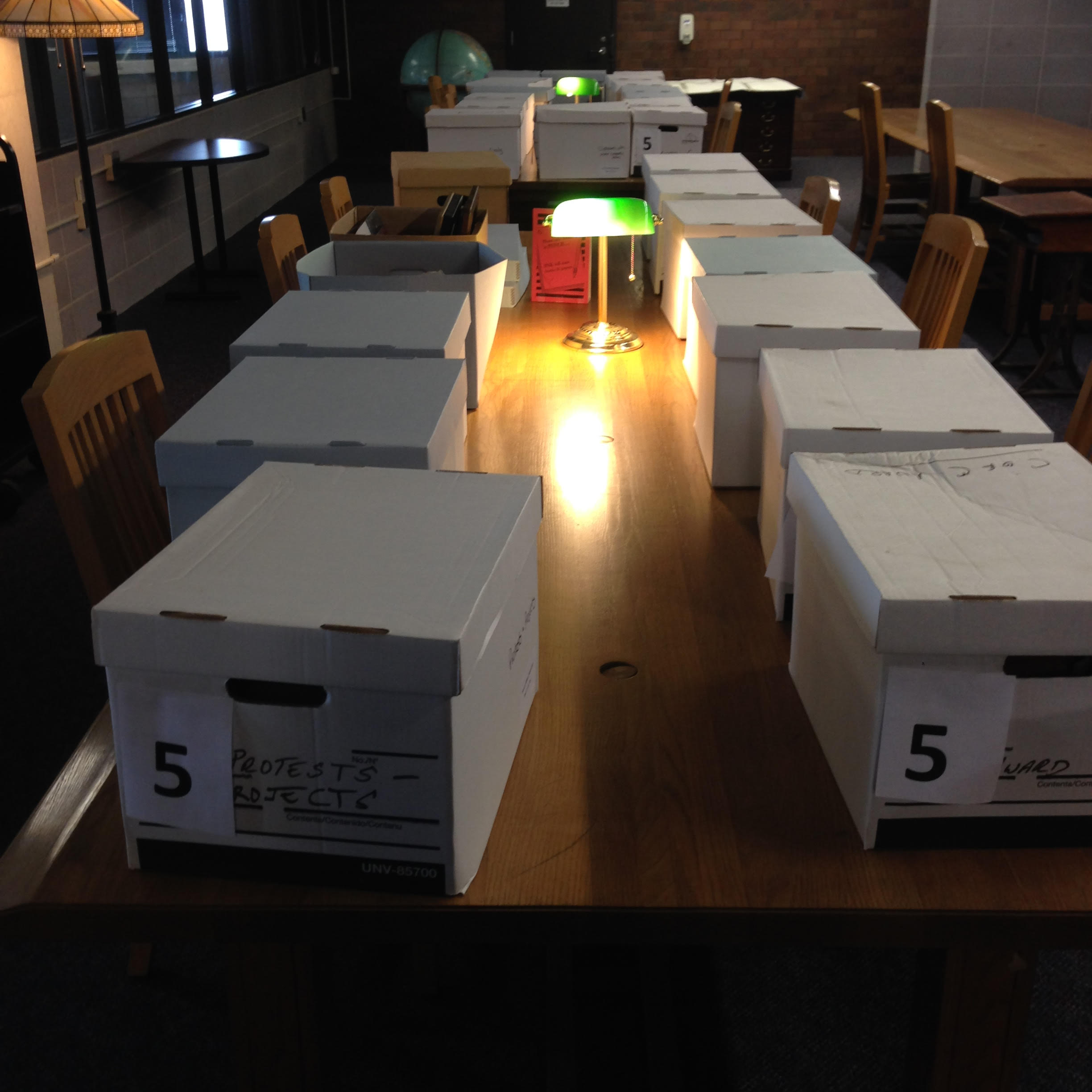 Peace Abbey Archives and Permanent Collection
The Peace Abbey and The Life Experience School gifted over 40 years of archival materials to the University of Massachusetts Boston in July of 2012. Twenty-six boxes of documents, photographs, CDs, videos, correspondence, newspaper articles, personal effects of notable pacifists and Courage of Conscience Award materials are available for peace and justice research and for public viewing at the Healey Library, University of Massachusetts Boston.
Visit the Peacemakers Table, the protest model of the 9 foot Gandhi Statue and the busts of Oscar Romero, Samantha Smith, Gandhi and Emily the Cow at UMB.
The archival holdings are in the following categories:
Peace Abbey Letters and Correspondence
Clip Board Notes and Messages
Display Case Materials
Courage of Conscience Awards
Emily the Cow
The Pacifist Memorial
Peace Pilgrim
Newspaper articles
Photographs
University Archives and Special Collections is open for onsite research Monday – Friday, 10:00 am to 4:00 pm. Please contact library.archives@umb.edu to schedule an appointment or to request reference assistance, and consult our online collections and Finding Aids at http://OpenArchives.umb.edu.
PASSING THE MANTLE
By Lewis Randa
November 12, 2025
“If I have seen further, it is by standing on the shoulders of giants.” — Sir Isaac Newton
As I have grown older, I have found myself reflecting less on what I have accomplished than on what has been entrusted to me. Newton’s words, which I came across more years ago than I can recall, remind me that none of us begins life’s journey alone. We inherit a world shaped by the countless souls of others, some whose names are remembered, many whose names have been forgotten. Their courage, compassion, sacrifice, and vision become the foundation upon which we build our own lives.
The question that eventually comes to each of us is not, “What have I achieved?” but rather, “Whose mantle have I received, and what mantle will I leave for others?”
I have sought to pick up where those who inspired me left off. Bobby Kennedy taught me that compassion belongs at the center of public life and that justice must always have a human face. Martin Luther King Jr., having picked up the mantle of Gandhi showed that nonviolence is not passive, but the greatest force available to those who seek to transform the world. Daniel Berrigan demonstrated that conscience requires resistance to accepted power. Howard Zinn reminded me to listen for the voices history too often ignores. Pat Farren, Barry Crimmins, and so many others who names adorn the walls at the Pacifist Memorial taught me that peace begins in the way we live with one another every day.
I have never imagined that I could equal these remarkable people. I simply hoped to carry their torch a little farther before placing it into other hands.
My own journey began humbly in Des Moines, Iowa. What eventually became my journey to Boston was an odyssey of conscience, a search that led me toward a way of life embracing nonviolence, civil disobedience, sacrifice, and the belief that conscience must not remain an idea, but must become a way of living.
That same conviction gave birth to the Peace Abbey. It was founded on the belief that the world’s great faith traditions, at their best, call humanity toward compassion, justice, forgiveness, and peace. Yet history also teaches us that religion, when imprisoned by creed, dogma, certainty, or the pursuit of power, has too often divided humanity and even justified cruelty and war in the name of God. The Peace Abbey has always sought to honor the deepest truths of peace found within every tradition while reminding us that no creed is greater than compassion.
The Pacifist Memorial was created in that same spirit. It is not merely a monument to those who opposed war. It is a reminder that every generation receives an unfinished moral inheritance. Those who come after us are under no obligation to preserve our ideas unchanged. Their responsibility is greater than that. They must discern what advances justice, what enlarges compassion, what deepens peace, and what best serves humanity. If anything I have helped to create deserves to continue, it will be because future generations judge it worthy of carrying forward.
As my own understanding of nonviolence deepened, I found myself asking whether compassion should end with our own species. That question eventually led my wife Meg and me to embrace vegetarianism and soon afterwards veganism, not as a claim of moral perfection, but as another expression of the same conscience that first led me to reject war. To live as cruelty-free as possible is, for me, simply another way of saying that peace is indivisible. Every living creature possesses an inherent worth. Human beings do not determine moral value. I hope our lives have encouraged others to widen the circle of compassion to include all creation.
If there is one lesson my journey has taught me, it is that none of us enters this world alone, and none of us leaves it alone. We are shaped by countless influences, many invisible to us. Through our own witness, others may discover those who inspired us, just as we discovered those who came before us. That is how the moral life continues, not by imitation, but by inspiration. If Peace Memorial Park exists for a reason, surely it is that.
The creation of the Courage of Conscience Awards emerged from the recognition that courage is one of humanity’s greatest forces for good. By honoring those who choose conscience over comfort, the awards affirm that moral courage is contagious. The lives of courageous people remind us that ordinary individuals can make extraordinary choices when guided by principle.
Stonewalk extended this message by transforming remembrance into action. Rather than simply observing the suffering caused by war, participants physically carried the weight of remembrance by moving the two ton memorial stone and caisson across the globe. In that act of shared effort and sacrifice was a profound lesson: peace requires participation. It requires people willing to carry burdens together.
The War Correspondents Memorial continues this same theme of passing the mantle. Journalists carry a mantle of truth. Through their witness, often at great personal risk, they reveal the realities of conflict and help the public understand the consequences of war. Many have sacrificed their lives in pursuit of truth, reminding us that an informed humanity is essential to the pursuit of peace.
The creation of the Animal Rights Memorial honoring Emily the Cow represents another expansion of conscience. My own journey toward vegetarianism and veganism grew from the same foundation as my commitment to pacifism: the desire to reduce suffering and extend compassion.
Nonviolence cannot end with our own species. If compassion has boundaries, it is incomplete. Every creature possesses inherent worth. No being is truly more important than another, even though human systems of power and control have often created hierarchies that justify domination. To live compassionately is to continually enlarge the circle of concern.
My wife Meg and I have sought to live this understanding through a commitment to cruelty-free living, not as a claim of perfection, but as an effort to align our choices with our conscience. The hope is not to impose a belief upon others, but to offer an example that may prompt others to reflect on the fact that peace begins wherever suffering is reduced.
Ultimately, none of us enters this life or leaves it on a journey that is entirely our own. We are shaped by countless people whose names we know and countless others whose names we never will. Through our lives and our witness, others may discover those who inspired us.
That is how the mantle is passed.
As I look back, I do not measure my life only by what was accomplished, but also by what remains unfinished. Every generation inherits an unfinished world. Every generation must decide how it will respond.
As those of us in the Baby Boom generation reach our final years, it is natural to wonder who will pick up where we leave off. Yet the truth is our task is not to dictate the future but to offer it our best. Those who follow must decide what is worthy of embracing, what must be transformed, and what should be left behind. Such is the responsibility of every generation.
If I have any legacy, I hope it is not only found in memorials, organizations, awards or even words. I hope it is found in having tried to choose conscience over convenience, even when it led to nonviolent actions that led to my arrest. Choosing peace over violence, and love over fear gets easier and easier if you allow those principles to settle in to the way you define yourself. You truly become who you claim to be.
In the end, I ask for nothing beyond trusting in the lives that may have been touched by my own. If someone is inspired to live more compassionately, to stand more courageously for justice, to seek reconciliation rather than revenge, to honor conscience over conformity, or to extend kindness to one more human being, or one more living creature, then my journey will have been worthwhile.
We do not own the mantle we wear. It was entrusted to us by those who came before. Our privilege is simply to wear it with humility, mend it where we can, and place it gently upon the shoulders of another, trusting that they will carry it farther than we ever could.
For in the end, the journey has never been about us. It has always been about humanity becoming a little more humane, the world becoming a little more peaceful, and love proving, once again, stronger than fear.
___________________________________________________________________
Archival biographical information gathered regarding the Peace Abbey founder:
Lewis Randa: A Life Guided by Conscience
For Lewis Randa, a life of peace began with a question:
Does this path have a heart?
Born in Des Moines, Iowa, on October 24, 1947, Randa came of age during the upheavals of the 1960s—a time of racial violence, political assassinations, the Vietnam War, and profound challenges to American institutions. Like many of his generation, he was confronted with a question that would become central to his life:
What does a person do when conscience comes into conflict with authority?
In 1969, that question became intensely personal. During Army basic training, holding an M-16, Randa realized that he was being trained to kill another human being. He could not reconcile that reality with his conscience. He became a conscientious objector and was ultimately discharged from the military.
What might have been simply an act of refusal became the beginning of a vocation.
Randa chose to turn conscientious objection into an affirmation of life. In 1972, he established the Life Experience School for children and young adults with disabilities. What began as alternative service became a decades-long experiment in a radically different understanding of human worth.
The school’s premise was simple and profound: people whom society too often regards as dependent or limited are not merely recipients of care. They have gifts, voices, abilities, and contributions that their communities need.
For Randa, this was already peacemaking.
Peace was not simply the absence of war. It meant creating relationships in which people were seen, valued, heard, and invited to contribute.
The Life Experience School became a place where young people with disabilities could participate in their communities, develop skills, serve others, and discover their own capacity to contribute. Over time, the school’s philosophy became an important foundation for many of the projects and relationships that followed.
One of the students who profoundly affected Randa was Norman Nylan, an autistic child who struggled with cancer before his death. Randa carried Norman’s cremated remains with him to Assisi, Italy, where in 1986 he participated in a gathering of religious traditions for the United Nations International Year of Peace.
The journey became both a personal memorial and a spiritual connection between the life of one beloved child and the larger human longing for peace.
Randa returned from Assisi with a vision: Could there be a place where people of different faiths and backgrounds could come together not merely to talk about peace, but to practice it?
The Peace Abbey
In 1988, that vision helped give birth to the Peace Abbey in Sherborn, Massachusetts.
The Peace Abbey became an experiment in making peace tangible—a place where spirituality, activism, education, art, remembrance, and social responsibility could meet.
It became home to the Pacifist Memorial, the Courage of Conscience Award, programs of nonviolence and social change, and a community of people who believed that peace could be practiced in ordinary life.
The Abbey also reflected Randa’s conviction that peace must be inclusive. Internationally known figures could be honored alongside people whose names were unlikely ever to appear in history books. People with disabilities could become contributors and teachers. Activists could find a place to gather. Artists could give physical form to moral questions. Memorials could give dignity to lives otherwise forgotten.
The visit of Mother Teresa became one of the significant moments in the history of the Peace Abbey and helped reinforce Randa’s conviction that a place devoted to peace could bring together people of very different backgrounds and traditions.
For Randa, the Peace Abbey was never simply a building.
It was an experiment.
Could a place embody the values that people hoped to see in the world?
Could prayer and protest, art and activism, education and spirituality exist under one roof?
Could people who disagreed about almost everything still discover common ground in the pursuit of peace?
The Peace Abbey became one answer to those questions.
Making Peace Visible
A distinctive characteristic of Randa’s work has been his effort to make invisible suffering visible.
Perhaps nowhere is that more evident than in Stonewalk, the 1999 project he conceived and organized to memorialize civilians killed in war.
A roughly 2,000-pound granite stone, inscribed Unknown Civilians Killed in War, was pulled approximately 500 miles from Massachusetts toward Washington, D.C.
The stone was heavy.
That was the point.
It gave physical weight to a reality that statistics can make abstract: the human beings who disappear into the numbers of war.
But Stonewalk was about more than the stone.
The journey itself became the memorial.
People walking together, pulling something seemingly impossible down the road, transformed an idea into an experience. The participants became part of the message simply by taking responsibility for moving the stone.
Randa’s work has repeatedly followed this pattern. He takes a moral question and gives it physical form.
A stone.
A school.
An abbey.
A memorial.
A Peace Chain.
A public protest.
A book.
A pledge.
A journey.
Civil Disobedience and Conscience
Randa’s activism has often taken the form of nonviolent direct action and, when conscience demanded it, civil disobedience.
He has protested war and militarism, racism, discrimination against people with disabilities, immigration policies, economic injustice, environmental destruction, and other threats to human dignity.
For Randa, civil disobedience has not been confrontation for its own sake. It has been a way of bringing private conscience into public life.
The question is never simply:
What do I believe?
It is:
What am I willing to do because I believe it?
That distinction has been important throughout his life.
He has repeatedly chosen actions whose outcomes were uncertain. Sometimes the action succeeded in its immediate objective. Sometimes it did not. But Randa has maintained that the willingness to act according to conscience has value independent of certainty about the outcome.
In this sense, civil disobedience becomes not merely political protest but a spiritual practice: a willingness to accept personal consequences rather than surrender one’s conscience.
The Peace Chain and Public Witness
The Peace Abbey’s Peace Chain became another vehicle for public witness.
Randa has participated in Peace Chain actions addressing war, militarism, immigration, disability rights, women’s rights, climate concerns, nuclear weapons, racism, and other issues affecting human dignity and the common good.
His activism has continued into his later years, including acts of civil disobedience undertaken as expressions of conscience concerning the direction of American public life.
For Randa, accepting legal consequences for nonviolent action can itself become part of the witness.
The punishment does not necessarily end the action.
It can become another opportunity to ask:
What does conscience require of me now?
Peace as Dignity
Randa’s understanding of peace has never been limited to the prevention of war.
His work with people with disabilities helped shape a broader understanding: peace is also the presence of dignity.
This conviction led him to participate in actions challenging language and cultural representations that he believed demeaned people with intellectual and developmental disabilities.
It also influenced the work of the Life Experience School, where people who were often regarded primarily as recipients of services were encouraged to become contributors to their communities.
For Randa, this was not charity.
It was relationship.
It was a recognition that every person has something to offer.
Extending Nonviolence Beyond Humanity
Randa’s understanding of nonviolence has also expanded beyond human beings.
Through the Life Experience School and later the Peace Abbey, he became involved in animal care, veganism, and animal advocacy.
This represented another extension of the same underlying question:
If life is sacred, where do we draw the boundaries of our concern?
His thinking increasingly challenged the separation people commonly make between human liberation, animal welfare, environmental responsibility, and spiritual awareness.
Peace, in this broader understanding, is not simply a political position concerning war. It is a way of being in relationship with life.
Quakerism and the Inner Source of Action
At the heart of Randa’s public work is a deeply Quaker understanding of conscience.
His peace testimony has developed over more than half a century.
The Quaker tradition of listening inwardly—to the Inner Light, to conscience, to a leading—has provided a spiritual vocabulary for his activism.
Randa has been shaped by the Quaker understanding of “that of God in everyone.” But his own spiritual exploration has continued beyond that familiar formulation.
His thinking has increasingly questioned the boundaries people ordinarily draw between God, humanity, nature, and the rest of existence.
This exploration became especially explicit in his book Being Us: Perceiving God, a Radical View.
The book explores a vision in which God is not understood as something separate from creation, but as inseparable from existence itself.
The question becomes not merely whether there is something of God within each person, but whether the divisions we ordinarily make between God, ourselves, other people, animals, and the natural world are ultimately real.
This spiritual understanding provides another lens through which to view Randa’s lifelong activism.
If life is fundamentally interconnected, then violence against another person—or the destruction and exploitation of other forms of life—cannot be understood as entirely separate from ourselves.
Land, Indigenous Peoples, and Reparation
Randa’s more recent work has brought his understanding of conscience into the history of land and Indigenous peoples.
The Native Land Reparation Pledge asks people who own property to consider committing, when they eventually sell it, a portion of the proceeds to the Indigenous community whose land they own and from which they will financially benefit.
The concept is deliberately framed as reparation rather than charity.
Its underlying question is one of conscience:
What do we owe to the people whose land has become part of our own wealth and security?
For Randa, the pledge represents another continuation of the pattern that has marked his life:
Identify a moral question.
Make it concrete.
Create a way for people to respond.
Invite others onto the path.
The Gregory Peace Prize
Randa’s work has also continued through his connection to the legacy of Dick Gregory.
Gregory’s commitment to nonviolence, civil rights, hunger strikes, and social justice influenced Randa’s own understanding of activism and conscience.
In recent years, Randa has helped develop the Gregory Peace Prize and related efforts to honor people whose lives embody peace and social responsibility.
This work reflects another recurring feature of his philosophy: honoring people while they are still among us and creating opportunities for one generation to pass its values to the next.
Recognition, in this context, is not simply about celebrating achievement.
It is about saying:
We see what you are doing. It matters. Keep going.
The Meaning of Recognition
Randa himself has received recognition for his work, including the Salem State University Peace Institute’s Champion of Peace Award.
Yet recognition has never appeared to be the central organizing principle of his work.
Indeed, one of his more revealing reflections is titled “Passing the Mantle.”
In considering the people who shaped his own life—including Robert F. Kennedy, Martin Luther King Jr., Daniel Berrigan, Howard Zinn, Dick Gregory, and others—Randa has increasingly described his life not simply in terms of what he accomplished, but in terms of what was entrusted to him.
His question has become:
Whose mantle have I received, and what mantle will I leave for others?
That may be one of the most useful ways to understand his legacy.
Randa’s work has always been cumulative.
He has received ideas, courage, questions, and inspiration from those who came before him, transformed them through his own experience, and attempted to place them into the hands of the next generation.
A Life Organized Around Conscience
Seen as a whole, Lewis Randa’s life does not fit neatly into one category.
He has been a conscientious objector, educator, Quaker, pacifist, activist, organizer, author, founder, advocate, spiritual seeker, and practitioner of civil disobedience.
But these are not separate identities.
They are different expressions of the same underlying conviction.
The young man who looked through the sights of a military rifle and realized that he could not participate in killing became the educator who helped young people with disabilities discover their own worth.
That educator became the founder of a place where people of different faiths could gather around the possibility of peace.
The peace center became a home for memorials, awards, art, prayer, dialogue, and activism.
The activist pulled a two-thousand-pound stone hundreds of miles to memorialize civilians killed in war.
The same activist stood with a Gandhi statue outside a financial institution, participated in protests concerning the treatment of people with disabilities, joined Peace Chain actions, and accepted the consequences of civil disobedience.
The spiritual seeker eventually wrote a book questioning the very boundaries between God, self, humanity, and creation.
And the elder activist continues to ask what conscience requires now—whether concerning war, authoritarianism, Indigenous land, disability, animals, or the responsibility of one generation to the next.
There is a continuity in all of it.
The question is not simply:
What do I believe?
It is:
What am I willing to do because I believe it?
That may be the most enduring lesson of Lewis Randa’s life.
For more than fifty years, his answer has been expressed through education, service, nonviolence, community, spiritual exploration, public witness, and acts of conscience.
He has repeatedly chosen paths whose outcomes were uncertain.
The Peace Abbey itself embodied that willingness: an experiment in creating a physical place where traditions of peace could meet, where famous peacemakers could stand alongside unknown activists, where people with disabilities could become teachers of community, where memorial stones could carry the grief of people killed in war, and where a single individual could discover that conscience need not remain private.
Randa’s life suggests that peace is not something that arrives fully formed.
It is built.
One person.
One relationship.
One act.
One stone.
One school.
One prayer.
One uncomfortable question at a time.
And perhaps, ultimately, one path with a heart.
The Legacy
The legacy of Lewis Randa is therefore not simply the institutions he helped create, the demonstrations in which he participated, the awards he received, or the causes he championed.
His deeper legacy is the proposition that conscience can become a way of life.
A conscience can become a school.
A conscience can become an abbey.
A conscience can become a memorial.
A conscience can become a journey.
A conscience can become a public witness.
A conscience can become a spiritual question.
And a conscience can become an invitation to others.
That invitation has been at the center of Randa’s life.
He has never claimed to have all the answers. Instead, he has continued to ask questions, listen for guidance, test his convictions through action, and invite others to join him.
His life has been less a declaration of certainty than an ongoing experiment in faithful living.
The question that began the journey more than fifty years ago remains the question that gathers all the pieces together:
Does this path have a heart?
For Lewis Randa, the answer has not been found by standing still.
It has been found by taking the next step.
And then another.
And inviting others to walk the path together.